• What We’re Reading, Watching, and Listening To: June 2026 Election Edition

    A roundup of news focused on real estate issues in the June 2026 state and local elections.

    California

    I Have Some Questions for the Democrats Who Want to Run California (New York Times): Ezra Klein hosted California’s top five Democratic candidates for governor to learn how each candidate plans to make progess on the issue of housing affordability.

    ‘Buckshot’ or moonshot? Dem candidates to replace Newsom offer grand plans for more housing (Politico): A central question for the Democratic candidates for California’s next governor is whether they will pursue many incremental “buckshot” fixes for more housing or implement a sweeping “moonshot” strategy to meaningfully increase supply.

    How California’s Next Governor Would Tackle Rent, Insurance and Housing Costs (KQED): The gubernatorial candidates have made housing a leading issue in their campaigns, including a focus on the need to lower construction costs and address homelessness, but diverge on certain housing issues.

    Here’s How California’s Next Governor Will Change Your Taxes (KQED): California’s leading gubernatorial candidates offer sharply different tax plans against the backdrop of affordability concerns and a projected state budget deficit.

    San Francisco

    The real estate industry picks its candidate in CA-11 (The Real Deal): Of San Francisco’s three leading congressional candidates, the real estate industry has contributed more to State Senator Scott Wiener’s campaign than to those of Supervisor Connie Chan or former congressional staffer Saikat Chakrabarti.

    Scott Wiener passed laws that made it easier to build in California. Can he do the same in Congress? (Cal Matters): If elected, Senator Scott Wiener’s record of passing ambitious pro-housing laws in California may be tested against the far slower, less centralized realities of Congress.

    S.F. Mayor Daniel Lurie’s edge at City Hall could hinge on these two supervisor races (SF Chronicle): Two closely watched San Francisco supervisor races have become proxy battles over Mayor Daniel Lurie’s pro-housing and moderate governance agenda, with challengers criticizing the Lurie-appointed incumbents’ support for denser zoning and their alignment with the mayor and his political allies.

    Categories: Blogs
  • HCD’s New Housing Law Fact Sheets: Guidance for Getting Projects Approved

    The California Department of Housing and Community Development (HCD) has released 22 new Housing Law Fact Sheets that provide concise, standalone summaries of key state housing laws. As state housing laws continue to expand and evolve, the fact sheets offer quick-reference guidance on statutory requirements, recent legislative changes, and relevant technical assistance letters. Topics that may be of interest to developers include:

    • Accessory Dwelling Unit law
    • Density Bonus Law
    • Housing Accountability Act
    • Housing Crisis Act (SB 330)
    • SB 35 / SB 423 streamlining
    • Permit Streamlining Act
    • Transit-Oriented Development (SB 79)

    HCD also recently revamped its Technical Assistance and Enforcement Letters Dashboard to make it easier to locate individual letters sent to local jurisdictions on a range of housing law implementation issues. Together, the materials offer a practical reference for navigating entitlement strategy, local agency obligations, and state housing-law compliance across California.

    Categories: Blogs
  • What We’re Reading, Watching, and Listening To: April 2026

    A roundup of news and multimedia from the Unfamiliar Terrain team:

    San Francisco

    Why the skyscraper race is back on when SF has plenty of empty offices (SF Standard): Although one-third of San Francisco’s 90 million square feet of office space remains vacant since the pandemic, several developers are pursuing plans to build the City’s next great skyscraper, with investor backing.

    Apartment rents soar to all-time highs — ‘San Francisco is rewriting its own record books’ (SF Business Times): San Francisco’s apartment rents are at their highest levels ever, driven by competition from tech workers. Local rent growth is significantly outpacing national trends.

    S.F. tech company expands its footprint as leasing surge lifts downtown office market (SF Chronicle): A year after signing a long-term, 150,000 square foot lease at One Sansome, Databricks has expanded its office footprint in the space by 90,000 square feet, showing strong momentum for the City’s office market.

    Bay Area

    Big Tech’s favorite landlord is leaning into housing. It’s daring others to follow (SF Standard): The Sobrato Organization, long known for developing major Silicon Valley corporate tech campuses, is turning significant attention toward affordable housing, marked by the opening of The Millton, a 120-unit all-affordable development in Redwood City.

    Newsom issues ‘final warning’ to cities over housing law violations — only one is in the Bay Area (Mercury News): Gov. Gavin Newsom issued notices to 15 jurisdictions, including Half Moon Bay, giving them 30 days to address housing law violations before potential referral to the Attorney General. The jurisdictions are more than two years behind on securing state-certified housing elements, and continued noncompliance could expose them to litigation, fines, loss of state funding, and builder’s remedy consequences.

    California and Beyond

    California considering a first of its kind idea to boost factory-built housing (CalMatters): The Legislature is considering a new proposal that would allow the state to serve as a financial backstop for factory-built housing projects. Under AB 2166, introduced by Buffy Wicks, the state would provide credit support to surety companies, enabling them to issue payment and performance bonds for factory-built construction.

    Tight Curves and Wide Horizons: The Return of Highway 1 (NY Times): A travel feature explores the reopening of California’s Highway 1 through Big Sur and reflects on how recurring landslides, climate pressures, and costly repairs continue to shape the future of one of the state’s most iconic transportation corridors.

    Cities scramble to comply with or fight major state housing law (CalMatters): With a July 1 deadline looming for local governments to introduce local “wiggle room” around SB 79, which broadly increases building height limits near major transit stops, cities around the state are exploring ways to tailor their own plans or buy themselves more time.

    A Bill Aimed at Creating Homes Is Leaving Plots Empty Instead (Wall Street Journal): A U.S. Senate housing bill would significantly restrict the build-to-rent industry, causing financing to pull back and putting projects on pause.

    California blew a hole in environmental planning law. Now, lawmakers are trying to fix it (CalMatters): California lawmakers are scrambling to more clearly define the new CEQA exemption for “advanced manufacturing” passed as part of the 2025 CEQA reform. The proposed fix would add limits and community protections, setting up a fight between environmental justice advocates seeking more review and industry groups arguing that streamlined approvals are needed for clean-energy manufacturing and economic development.

    Categories: Blogs
  • What We’re Reading, Watching, and Listening To: March 2026

    A roundup of news and multimedia from the Unfamiliar Terrain team:

    San Francisco

    Proposed waterfront tower could test California’s power to override S.F. height restrictions (SF Chronicle): A proposed waterfront tower project shows how new high-rise development proposals are reshaping debates over design, density, and growth along San Francisco’s northeastern waterfront.

    The Marina Safeway may be SF NIMBYs’ last stand (SF Standard): A controversial proposal to redevelop the Marina Safeway site into a high-rise housing complex has become a focal point for debates about neighborhood opposition and the growing influence of California’s pro-housing state laws.

    Scaled-back Potrero Yard plan clears way for 100 affordable homes in S.F. (SF Chronicle): SFMTA has scaled back the redevelopment plan (reduced from 465 to 100 units) for the Potrero Yard bus facility, with a nonprofit developer building the new affordable housing on the Bryant Street side of the site, rather than on top of the bus yard facility as originally planned.

    Office-to-housing conversion planned for historic downtown S.F. building (SF Business Times): Local conversions of office buildings to housing have been much-discussed but rarely proposed; now a proposal 901 Market Street will test whether regulatory changes will help these projects pencil.

    S.F. leaders propose cutting city’s transfer tax to spur stalled housing projects (SF Chronicle): A proposal by San Francisco leaders to reduce the city’s real estate transfer tax seeks to revive stalled housing projects and catalyze new residential development.

    Here’s how much it costs to buy S.F.’s Transamerica Pyramid (SF Chronicle): Transamerica is under contract to sell for approximately $700 million, likely at a loss for its current owners after a costly renovation, but the deal suggests renewed global investor interest in San Francisco’s highest-end office properties despite the city’s relatively weak broader office market.

    Bay Area

    The Napa town where it’s easier to win a Michelin star than build an apartment (SF Standard): The debate over the proposed Yountville Commons workforce housing project intensified after celebrity chef Thomas Keller publicly criticized the town’s plans, arguing local workers need larger units and more parking.

    California Forever Eyes New Trump Initiative to Bring Its Shipbuilding Plans to Life (KQED): California Forever proposes to use a recent “Maritime Prosperity Zone” initiative to secure federal support and incentives for a regional shipbuilding revival in the California Delta, tied to its broader Solano County development plans.

    Chevron’s HQ left California. A developer now plans to add thousands more homes in its place (SF Chronicle): Sunset Development proposes to turn Chevron’s former San Ramon headquarters and surrounding office park into a mixed-use community with thousands of new homes, retail, and other amenities, reflecting a broader shift away from suburban office campuses in the remote-work era.

    Concord rezoning paves the way for 1,000 homes in single-family neighborhoods (SF Business Times): The East Bay city completed rezoning to implement its housing element, avoiding potential “builder’s remedy” projects and creating higher-density opportunities in a traditionally low-density community.

    California and Beyond

    Senate passes bipartisan housing bill targeting large investors and easing regulations (NPR): The largest federal housing bill in decades has passed the U.S. Senate on an 89-10 vote, focusing on spurring supply and limiting institutional owners’ ability to purchase single-family homes.

    L.A. council puts off yet another attempt to rewrite the city’s ‘mansion tax’ (LA Times): A Los Angeles City Council vote to place revisions to the city’s controversial “mansion tax” (Measure ULA) before voters was delayed after officials opted to send the proposal back for further review amid debate over whether the tax is hindering housing development or funding critical homelessness programs.

    Categories: Blogs
  • San Francisco’s Family Zoning Plan: What Developers Need to Know

    After months of hearings, numerous proposed amendments, and substantial public comment for and against, the San Francisco Family Zoning Plan passed by a 7-4 vote at the Board of Supervisors, and was approved by Mayor Lurie on December 12. At a high level, the Family Zoning Plan is intended to provide zoning capacity for 36,000 new housing units, as part of San Francisco’s implementation of its 2023-2031 Housing Element. This increased zoning capacity is largely concentrated in San Francisco’s northern and western neighborhoods, along existing public transit corridors.

    The key component of the Family Zoning Plan is the Housing Choice-SF Program, which allows developers to opt in to a local density bonus program by meeting the City’s affordable housing requirements. Under Housing Choice-SF, projects can qualify for the local program even if they provide affordable units off-site or through land dedication; projects with fewer than 25 units can also elect to subject all units to rent control rather than providing on-site affordable units. By contrast, the State Density Bonus Law and related approval pathways such as SB 35/423 require affordable units to be provided on-site to unlock bonus density and ministerial approvals.

    Projects that opt in can use the new local program to:

    1. Obtain relief from applicable numeric density controls (for example, one unit per 600 square feet of lot area), and instead be governed by form-based density controls, such as height, bulk, setbacks, and lot coverage.
    2. Unlock building height that exceeds base zoning, in many locations by one to two stories, but in some locations by five or more stories.
    3. Modify or eliminate otherwise applicable development standards such as required open space, dwelling unit exposure, and rear yards, and obtain up to 15% reductions of many other quantitative development standards.
    4. Utilize an administrative review process with Planning Director-level approvals and limited appeal opportunities.

    If a developer elects to use Housing Choice-SF, that developer must forgo use of State Density Bonus Law. The Planning Department’s September staff report to the Planning Commission acknowledges that in some circumstances, State Density Bonus Law could allow for projects that exceed heights achievable through Housing Choice-SF.

    At any potential development site, a developer will need to evaluate, among other criteria, the following:

    1. Between Housing Choice-SF and State Density Bonus Law, which path would allow a denser or taller project?
    2. Even if Housing Choice-SF would result in less density or height, does its administrative review process, with limited appeals, make it a more desirable path? Or could a State Density Bonus approach, especially if combined with a ministerial review through SB 35/423, provide a comparably streamlined approach with greater density or height?
    3. Are there any Planning Code compliance issues that are better or more effectively solved through use of Housing Choice-SF, or would State Density Bonus Law waivers and concessions achieve a similar or better result?
    4. Does the affordable housing flexibility provided by Housing Choice-SF, discussed above, make it a more attractive option?

    The Family Zoning Plan also expands protections for existing residential tenants and historic structures, and provides assistance for businesses displaced by new residential development.

    The Coblentz Real Estate Team is ready to assist as developers weigh their options under Housing Choice-SF and State Density Bonus Law.

    Categories: Blogs
  • What We’re Reading, Watching, and Listening To: November 2025

    A roundup of news and multimedia from the Unfamiliar Terrain team:

    San Francisco

    S.F. supervisors back tenant, small-business protections in Lurie’s ‘Family Zoning’ plan (SF Chronicle): Mayor Lurie’s family zoning plan would raise height limits and add density on the north and west sides of the city, but some elected officials, residents, neighborhood groups, and organized labor are pushing back, and various amendments are being considered.

    New report says SF Family Zoning Plan will fall short of state housing mandates (SF Standard): The city economist’s analysis finds rezoning could yield far less housing than the Planning Department projects. Report available here.

    Demand for SF offices is highest in the country (SF Standard): Demand for office space in San Francisco has doubled year over year, with particularly strong growth in the tech sector.

    S.F.’s North Beach divided over proposal that could shake up retail in the historic neighborhood (SF Chronicle): Some businesses and residents are worried that a change in zoning could mean that neighborhood staples could lose protections that have helped them survive, while supporters believe that the legislation will make it easier to fill vacant spaces.

    Bay Area

    Plan Bay Area 2050+, draft plan and Draft EIR out for comment (MTC and ABAG): After more than two years of public discussion, technical analysis and refinement, the Metropolitan Transportation Commission (MTC) and the Association of Bay Area Governments (ABAG) have released Draft Plan Bay Area 2050+ for review and comment.

    Newsom authorizes Bay Area transit tax measure for 2026 ballot (CBS News): Gov. Newsom signed legislation authorizing a ballot measure for Bay Area voters to decide whether to increase sales taxes to fund transit.

    BART made it easier to pay. Here’s how many riders are tapping the new system (SF Standard): Ridership is up 25% since January, and agency officials say the recent rollout of contactless payment may be the reason.

    Homes in this Bay Area region are selling at a slower pace — and for less. What’s behind the cooldown? (SF Chronicle): Return-to-office mandates may explain shifting demand from further out suburbs to San Francisco and the South Bay.

    Marin County town officials renew fight over proposed housing, even as a recall election looms (SF Chronicle): Fairfax’s mayor and vice mayor are facing a recall election that’s tied to housing development in the Marin County town.

    California and Beyond

    Newsom signs major housing bill allowing for dense construction near transit (SF Standard): Senate Bill 79 upzones heights near high-quality transit in eight counties, including four Bay Area counties (San Francisco, Alameda, San Mateo, and Santa Clara). We’ve written about the bill here.

    Why California’s historic housing law gave activists a new reason to battle the bus (CalMatters): Opponents to dense housing developments in Los Angeles County are organizing against planned bus routes in response to Senate Bill 79.

    Condos Provide Affordable Homeownership, So Why Doesn’t California Build More of Them? (SPUR): High insurance costs for condo builders, resulting from construction defect liability laws, may disincentivize condo development.

    The Twin Cities of Grass Valley and Nevada City, Calif. (NY Times): Exploring two towns in the Sierra foothills and a recent influx of new residents.

    This California town is battling the state’s deepest housing conundrum (SF Chronicle): Nevada County grapples with the need for more housing in wildfire country.

    Categories: Blogs
  • Coming to a Major Transit Stop Near You: Upzoning Under SB 79

    Update: Governor Newsom signed SB 79 into law on October 10, 2025

    California Legislature Passes New Bill to Encourage More Homes Near Transit

    Capping off a session that achieved major CEQA reforms for housing development, the California Legislature has sent new transit-oriented housing legislation to the Governor’s desk, which is expected to be signed by the October 12 deadline. Senate Bill 79, the “Abundant and Affordable Homes Near Transit Act” (Wiener), effectively upzones sites near high-quality transit to create more housing opportunities. Below we summarize SB 79 and its eligibility requirements.

    Key Points

    • The bill affects cities in eight urbanized counties that are well-served by transit.
    • In these areas, the bill allows building height limits of 55 to 95 feet and density of at least 30 units per acre, depending on proximity to and quality of transit.
    • Projects over 10 units must meet basic inclusionary housing requirements.
    • No specific labor requirements apply unless the building is over 85 feet in height.
    • The bill expands eligibility for CEQA-exempt streamlining under SB 423, and lowers the inclusionary housing requirement.
    • Local jurisdictions have options to exempt certain sites from the bill, or adopt an alternative plan that achieves the same development capacity.

    What projects qualify for SB 79?

    SB 79 applies to projects in proximity to a “transit-oriented development” (TOD) stop, which is:

    • A “major transit stop” (as defined in Public Resources Code Section 21064.3); and
    • In an “urban transit county,” defined as a county with more than 15 passenger rail stations. In the Bay Area, this means San Francisco, Alameda, San Mateo, and Santa Clara Counties – with Contra Costa County notably omitted – as well as Sacramento, Los Angeles, Orange, and San Diego Counties.

    Once signed, SB 79 will become effective on July 1, 2026, unless a local jurisdiction adopts an HCD- approved ordinance or local transit-oriented development alternative plan before then.

    What are the requirements for a “transit-oriented housing development”?

    • The project must be a “housing development project” as defined in the Housing Accountability Act (HAA).
    • The site must be zoned residential, mixed or commercial, and be within at least ½ mile of a transit-oriented development stop.
    • The project must include:
      • At least five dwelling units;
      • Density of either 30 dwelling units per acre, or the minimum density required under local zoning; and
      • Average total floor space per unit cannot exceed 1,750 square feet.
    • Projects with more than 10 units must include housing affordable to households at the following levels based on Area Median Incomes, unless the local ordinance mandates a higher percentage:
      • 7% of units: extremely low income households;
      • 10% of units: very low income households; or
      • 13% of units: lower income households.
    • The project cannot be located on a site that has had more than two rent-controlled units within the past seven years.
    • The project must comply with height, noise, and safety standards of adopted airport land use plan or zone, and fire safety standards.
    • Projects are also able to take advantage of density bonus concessions, depending on the minimum density achieved for a given project.
    • Finally, no labor requirements apply to buildings 85 feet in height or less. For any building over 85 feet in height, the project must comply with prevailing wage requirements and must use a skilled and trained workforce.

    SB 79 also allows local transit agencies to develop on land owned by the agency, subject to specific requirements, including paying prevailing wages and using a skilled and trained workforce.

    What development standards apply to projects under SB 79?

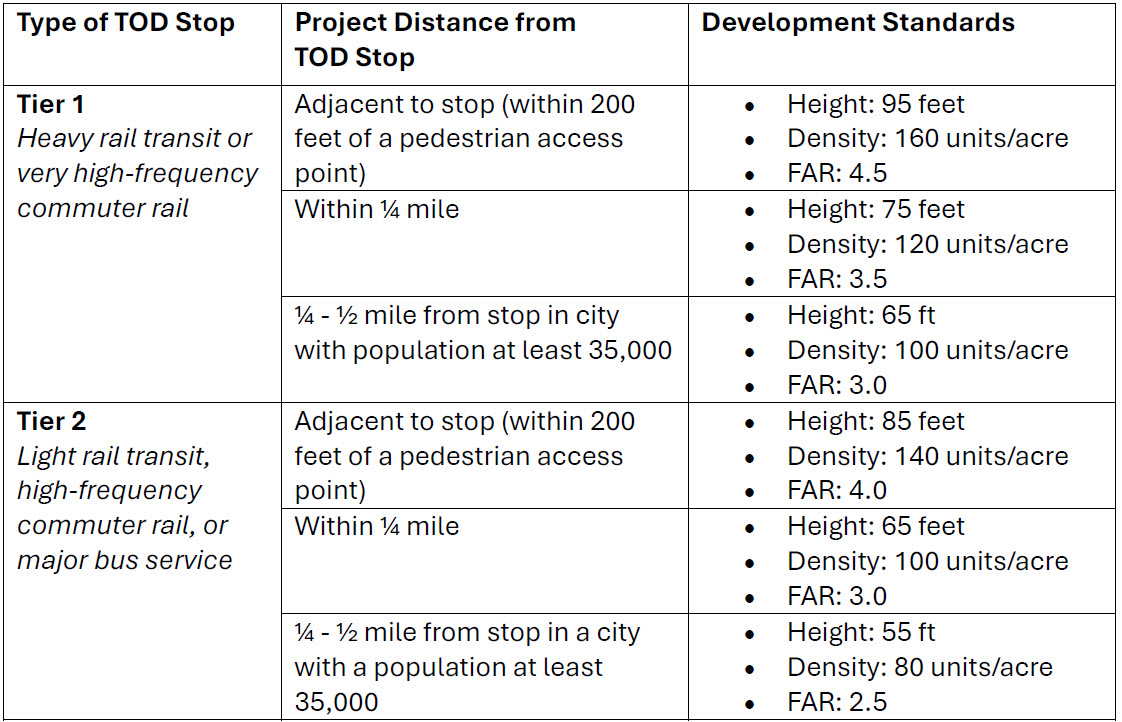
    SB 79 limits a local agency’s ability to restrict certain development standards for transit-oriented housing developments. It also distinguishes between types of TOD stops based on the type of transit that serves the stop.

    • Tier 1 TOD stops are served by heavy rail transit or very high-frequency commuter rail (such as BART and Caltrain).
    • Tier 2 TOD stops are those that are not Tier 1, and are served by light rail transit, high-frequency commuter rail, or major bus service (such as San Francisco Muni; not including Amtrak or the California High-Speed Rail).

    Under SB 79, local agencies cannot set limits below the following standards depending on the project’s proximity to the TOD stop:


    Are projects under SB 79 eligible for streamlined approval?

    Projects under SB 79 may be eligible for streamlined ministerial approval under SB 35/423, which provides a streamlined ministerial approval process for developments in localities that have not made sufficient progress toward housing targets, with certain significant changes that will make that process attractive for more projects. For eligible projects, SB 35/423 mandates a very fast process (approximately 90 to 180 days, depending on project size) and one that is exempt from CEQA. However, in most jurisdictions, projects are required to include 50% low income units to qualify for SB 35/423, and as a result, it has primarily been used by 100% affordable projects.

    SB 79 makes two significant changes to this framework. First, eligibility does not depend on whether the jurisdiction has met its housing allocation targets, meaning that it can be used in every jurisdiction where SB 79 applies, regardless of the jurisdiction’s Regional Housing Needs Assessment compliance. Second, the affordability level for all projects is 10% very low income (rental projects) or 10% low income (for-sale projects). While SB 35/SB 423 contains a number of other site criteria, most urban infill sites will qualify.

    If a project does not seek streamlined approval, it will be reviewed under the jurisdiction’s standard development review process and the HAA.

    How does HAA compliance work under SB 79?

    A proposed housing development project that is consistent with the requirements of SB 79 and applicable “objective” standards as defined under the HAA is “deemed consistent” under the HAA.

    Starting on January 1, 2027, a local agency that denies a housing development project in a high resource area will be presumed to be in violation of the HAA.

    Can local agencies exempt areas within their jurisdiction from SB 79?

    SB 79 also provides avenues for local agencies to exempt certain areas from SB 79. Local agencies can:

    • Exclude certain sites from SB 79 eligibility, including if there is no walking path of less than a mile connecting to the TOD stop.
    • Exempt an area as an “industrial employment hub,” as defined in the statute, therefore excluding housing as a permitted use on the site.
    • Adopt a “transit-oriented development alternative plan,” as defined in the statute, that generally retains the same development capacity that would be available under SB 79.

    Like other recent legislation intended to expand housing development opportunities in California, SB 79 is complex and there will undoubtedly be bumps along the way in its implementation. Please reach out to the Coblentz real estate team with any questions about this important new legislation.

    Categories: Blogs
  • What We’re Reading, Watching, and Listening To: September 2025

    A roundup of news and multimedia from the Unfamiliar Terrain team:

    San Francisco

    San Francisco Family Zoning Plan Updates (SF Planning): As of late July, the Planning Department has updated the draft zoning height maps as part of its proposed Family Zoning Plan, which aims to expand housing affordability and availability by allowing for increased density. Critics of this Plan are ramping up their political pressure. If the rezoning is not completed by January 2026, the City risks losing certification of its Housing Element, which could open the door to “builder’s remedy” projects and other penalties from the State.

    S.F. may soon ban natural gas in homes and businesses undergoing major renovations (SF Chronicle): The City may soon ban natural gas in residential and commercial buildings undergoing major renovations (with carve-outs), a move that builds on the City’s existing ban on natural gas in new buildings.

    Cars will soon return to section of San Francisco’s Market Street (SF Chronicle): Under a new City pilot, commuters once again have the option to hail Waymo robotaxis or summon Uber or Lyft black cars at new locations on Market Street, all scattered along a downtown stretch that is closed to private automobiles.

    Bay Area

    The Bay Area is lagging on lofty housing goals. Here’s how far behind each city is (SF Chronicle): Cities across the Bay Area are lagging behind their state-mandated housing goals as high housing costs force out low-income families and construction slows across the state.

    Bay Area housing production is frozen, forcing developers to take riskier bets (SF Standard): Most market-rate projects remain infeasible to build due to high interest rates and construction costs, despite steady rent growth.

    Financing Climate Adaptation and Hazard Mitigation, Part 1: Federal Cuts Increase Bay Area’s Risks (SPUR): The first in a series of articles examining climate adaptation and hazard mitigation financing at the federal, state, and local levels, including current funding gaps and innovative models to bridge them.

    This Bay Area city bet on warehouses over tech offices. Here’s why it paid off (SF Chronicle): Fremont is now the biggest employment center for advanced manufacturing on the West Coast, home to 900 companies that make physical products.

    Berkeley could OK taller buildings on 3 popular streets (Berkeleyside): In a push to bring more housing to wealthy neighborhoods, the city is looking to raise height limits for new buildings.

    San Jose becomes first California city to allow sale of ADUs as condos (SF Chronicle): San Jose approved the state’s first backyard accessory dwelling unit to be sold as a condominium on Thursday, creating a new path to affordable homeownership under legislation that took effect in 2024.

    California and Beyond

    Will New CEQA Reforms Bring More Housing to California? (KQED): A panel discussion on how much of a difference CEQA reform could make in addressing the Bay Area’s housing shortage and where – and when – we might see new developments.

    California Has a Transit Cost Problem — and a New Appetite to Deal With It (SPUR): California has a reputation for costly and slow transit infrastructure development. But the state is attempting to develop ways to cost-effectively fast-track transit projects without jeopardizing public accountability.

    Homelessness is finally dipping across California. These Bay Area counties saw double-digit declines (SF Chronicle): Across 15 California counties that conducted consecutive counts in 2024 and 2025, all but two reported declines in their overall homeless populations.

    As Natural Disasters Become More Costly, Homeowners Foot the Bill (NY Times): Data from the Federal Emergency Management Agency shows that the average property damage from fires and severe storms is trending upward in many parts of the country, potentially costing homeowners more to recover.

    Climate-Driven Housing Mandates Show Promise, But Face Real-World Barriers (MIT Center for Real Estate): While there is broad support for climate goals and recognition that building decarbonization is essential, many apartment owners and managers are struggling to keep pace with the complexity and cost of implementation.

    The Quintessential Urban Design of ‘Sesame Street’ (NY Times): Over its several decades, the show’s setting has always been both realistic and idealistic. And it has evolved, much like the New York City streets that inspired it.

    Categories: Blogs
  • 2025 CEQA Reforms: What Developers Need to Know

    By Miles Imwalle, Megan Jennings, Elena Neigher, Alyssa Netto, and Craig Spencer

    Governor Gavin Newsom signed two budget trailer bills on June 30, 2025, enacting the most substantial reforms to the California Environmental Quality Act (CEQA) in over five decades. To help you navigate these important changes, we have prepared a three-part summary of budget trailer bills Assembly Bill 130 and Senate Bill 131:

    New CEQA Exemption for Infill Housing Development Projects: What it Means for Developers 

    AB 130 and SB 131 were adopted on the last day of the 2024-25 fiscal year after the Governor made it clear he would not approve the budget without meaningful CEQA reforms. While not the sweeping “rollback” of environmental review that some sources have claimed, the legislation will undoubtedly smooth the road for approval for many infill housing projects. In this post, we focus on the criteria for using the new exemption for housing development projects in AB 130. Read more here.

    “Near-Miss” CEQA Streamlining: New Option to Reduce Scope of Review for Housing Development Projects 

    SB 131 includes a new CEQA process that limits the environmental review required for “near-miss” housing development projects—those projects that meet all criteria for a CEQA exemption, except for a single disqualifying condition. Specifically, the environmental review in these instances is restricted to analyzing impacts stemming exclusively from the single condition that disqualifies the housing project from receiving a statutory or categorical exemption. Read more here.

    CEQA Transportation Mitigation Fees and Other Key Reforms in AB 130 and SB 131 

    In our third update on the important changes in budget trailer bills AB 130 and SB 131, we cover changes to the mitigation options for vehicle miles traveled (VMT), additional focused CEQA exemptions, and other amendments to land use processes. Read more here.

    The Coblentz Real Estate Team has extensive experience with the state’s latest land use laws and can help to navigate their complexities and opportunities. Please contact us for additional information and any questions related to the impact of this legislation on land use and real estate development.

  • CEQA Transportation Mitigation Fees and Other Key Reforms in AB 130 and SB 131

    This is our third update on the important changes in the two budget trailer bills, AB 130 and SB 131, after previous posts addressing the new CEQA exemption for infill housing and the “near miss” CEQA streamlining process. While the first two posts covered the most significant changes, the legislation also introduced changes to the mitigation options for vehicle miles traveled (VMT), additional focused CEQA exemptions, and other amendments to land use processes.

    New VMT Payment as Mitigation Option

    SB 743, enacted in 2013, directed that CEQA’s analysis of transportation impacts no longer study intersection “level of service,” or congestion, and instead study VMT, a requirement that finally went into effect on July 1, 2020. The topic has been challenging for many projects, especially outside of transit-rich urban areas and projects that do not fit into residential, office, or retail categories. The ruling in Cleveland National Forest Foundation v. County of San Diego (2025) 110 Cal.App.5th 948 created additional uncertainty by rejecting locally adopted thresholds that “screened out” infill and smaller projects because the City relied on generalized assumptions rather than location specific evidence. While the court acknowledged that SB 743 was intended to promote infill development, it found that infill development does not by definition have a less than significant VMT impact. AB 130 creates a new funding regime allowing projects to mitigate their VMT impact, at the lead agency’s discretion, by paying a fee to fund transit-oriented development and affordable housing.

    The fees will be deposited into a fund administered by the Department of Housing and Community Development (HCD) that will fund VMT reducing projects, including “affordable housing or related infrastructure projects, including infrastructure necessary for higher density uses.”

    The theory is that this option will make mitigating VMT impacts predictable and feasible. However, AB 130 does not specify the amount of the fee, nor does it confirm whether payment of the fee will fully mitigate project impacts. The Governor’s Office of Land Use and Climate Innovation (LCI, previously the Office of Planning and Research) is required to issue initial guidance for using this new mitigation by July 1, 2026 that will set forth the following details:

    • Methodology for determining the amount of the fee;
    • Definition of “location-efficient areas” that reflects a reasonable nexus between the transportation impact of the development project and the location of the project to be funded as mitigation;
    • Process for validating that the fee satisfies mitigation requirements for significant transportation impacts; and
    • Methodology for estimating the anticipated reduction in VMT resulting from payment of the fee.

    LCI is required to issue subsequent guidance at least once every three years, which includes starting the rulemaking process for any subsequent guidance by January 1, 2028.

    The unresolved issues that LCI is directed to resolve are challenging, and critical to whether the mitigation is a feasible and predictable option to address VMT. When LCI starts the official rulemaking process, it will include opportunities for developers and other interested parties to provide input. Developer input may be critical to making the program workable.

    Additional CEQA and Land Use Amendments

    In addition to the topics we’ve written about before and above, the two bills also provide a number of significant changes:

    • Legislative Intent of CEQA: SB 131 clarifies the legislative intent that CEQA is primarily an environmental safeguard that should not be used for reasons unrelated to environmental protection (e.g., economic leverage, competition, or to delay projects). While this intent language does not change CEQA requirements, it will be an important tool in litigation regarding whether a CEQA petitioner is using the litigation to pursue an improper, non-environmental purpose.
    • Coastal Commission Appeals: AB 130 narrows the type of residential projects that can be appealed to the Coastal Commission.
    • Removal of Sunset Dates: A number of important provisions in 2019’s SB 330 had sunset dates, which were originally set for January 1, 2025, and which were later extended until January 1, 2034. AB 130 eliminates several of these sunset dates entirely, including: the “vesting” provided by submittal of a preliminary application; limiting the number of hearings to five; requiring that historic properties are identified up front; and prohibiting enacting policies that are more restrictive to housing in areas already zoned for housing.
    • Housing Element Rezoning Exemption: SB 131 creates a new statutory exemption that exempts from CEQA certain rezonings that implement a schedule of actions in an approved housing element.
    • Advanced Manufacturing Exemption: SB 131 also creates a statutory exemption for projects consisting exclusively of “advanced manufacturing” facilities, as defined in Public Resources Code section 26003, when located on sites zoned exclusively for industrial uses and not located on certain “natural and protected lands” as defined in Public Resources Code section 21067.5.
    • Administrative Record: SB 131 narrows the scope of the administrative record contents for CEQA litigation by excluding staff notes, memoranda related to the project or CEQA compliance, and other internal agency communications (unless the project includes certain distribution centers or oil-and-gas infrastructure). Compiling the administrative record can be one of the more time consuming steps in CEQA litigation, so this is an important reform.
    • Temporary Freeze on Local Agency Modifications to Building Codes: Effective October 1, 2025, through June 1, 2031, AB 130 bars cities or counties from establishing more restrictive building standards, including green building standards, applicable to residential units, unless limited exceptions apply.
    • Urban Infill Mapping: SB 131 tasks LCI with posting, by July 1, 2027, a statewide online map of “eligible urban infill sites” in every Census-defined urbanized area or cluster, which may qualify for infill-based exemptions or streamlining.

    This list is not exhaustive, but it is indicative of the extensive adjustments the Legislature has made to remove barriers for housing and other prioritized development projects. The Coblentz Real Estate Team has extensive experience with the state’s latest land use laws and can help to navigate their complexities and opportunities. Please contact us for additional information and any questions related to the impact of this legislation on land use and real estate development.

    Categories: Blogs